Official 2026 Date: Sunday, March 22, 2026 – confirmed by race entries listing the event in the 2026 calendar.
Start Time: Early morning 5:00-5:30 am (standard start for this event)
Course: Race begins at Joe Laveist Sport Park in San Nicolas and finishes in Oranjestad near Alhambra Casino & Shops – making it a full traverse of Aruba’s length.
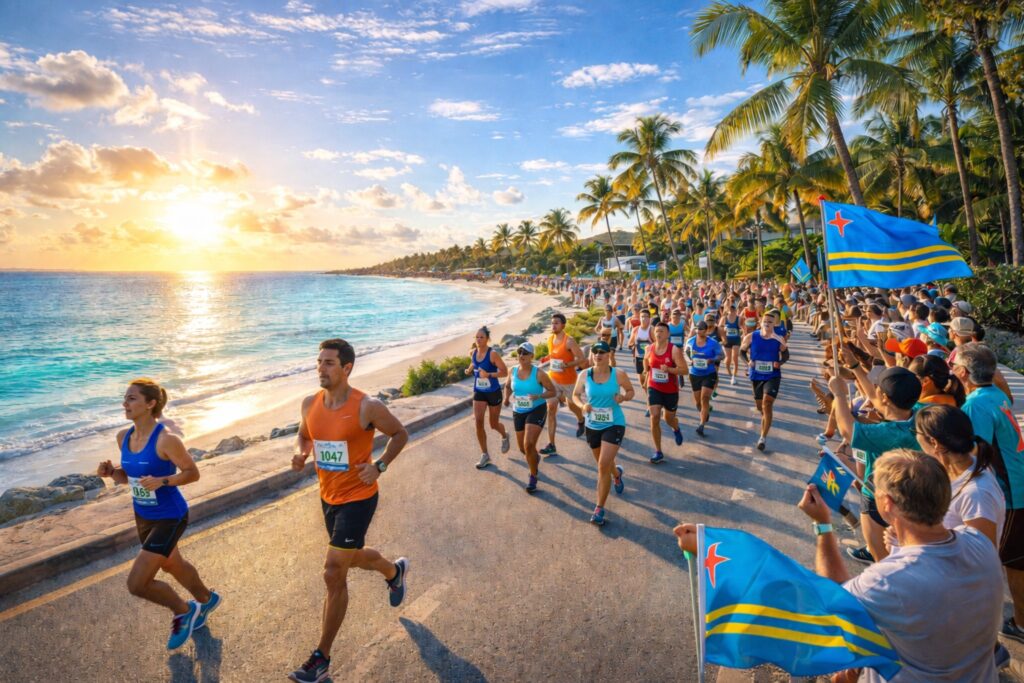
The Aruba International Half Marathon (21K) 2026 is scheduled for Sunday, March 22, 2026, and once again invites runners from around the globe to challenge themselves on one of the Caribbean’s most scenic point-to-point road courses. Starting in the quiet streets of San Nicolas before dawn and finishing in the bustling coastal capital of Oranjestad, this half marathon covers 21.1 km (approx. 13.1 miles) of varied terrain and island character.
Unlike track events or loop courses, Aruba’s half marathon delivers an immersive, cross-island experience: runners traverse gently rolling stretches of highway, coastal outlooks, and local neighborhoods before concluding steps near the historic Alhambra Casino & Shops – an energetic finish zone that blends racing achievement with tropical celebration.
With an early morning start (typically around 5:00–5:30 am) to beat heat and humidity, this race rewards thoughtful pacing, preparation, and appreciation for the island’s natural beauty. It is organized by IBISA Aruba, a group deeply tied to the local running community, and has a time limit that encourages strong performance without compromising participant safety.
Whether you’re a competitive half-marathoner seeking a unique Caribbean challenge or a destination runner combining sport with island travel, Aruba’s 21K stands out for its refreshing route, supportive local community, and the sense of accomplishment that comes from crossing an entire island on foot.
History & Prestige of the Race
Among Aruba’s annual athletic events, the International Half Marathon has become an enduring classic, drawing runners back year after year. While the overall calendar also includes shorter races and relays, the 21K retains a singular place due to its status as one of the island’s longest traditional road races.
The race’s roots stretch back several decades, when local running clubs and athletic associations first began organizing island-wide competitions to promote healthy lifestyles. Over time, the half marathon gained prominence as both a competitive race and a destination event – one that offers not just a personal performance goal but also a way to experience the island’s varied communities.
Competitors often speak of the race’s unique charm: it’s neither a mass urban marathon with tens of thousands of entrants nor a narrow trail run secluded in wilderness. Instead, the course reflects Aruba itself – open, welcoming, and scenic, balanced with enough challenge to reward preparation and grit.
In recent years, the event has attracted runners from around the world, drawn by both the promise of a personal best and the allure of crossing Aruba from one end to the other. While not formally certified as AIMS/World Athletics standards like some larger marathons, the race nonetheless enjoys recognition in the Caribbean running community and sits proudly on many runners’ calendars as a must-run 21K.
The Route Experience
The defining characteristic of Aruba’s 21K is its cross-island narrative. Unlike loop courses that repeat scenery, this route tells a geographical story from east to west.
The race begins in San Nicolas, a culturally rich town known for murals and artistic expression. Pre-dawn air tends to be calm, with temperatures hovering in the mid-70s Fahrenheit (low to mid-20s Celsius). The first kilometers allow runners to settle into pace on relatively flat terrain.
As the sun begins to rise, the course opens toward wider roadways with expansive skies and occasional coastal glimpses. Aruba’s trade winds can either assist or challenge runners depending on direction. Some stretches are exposed, requiring mental focus and steady pacing.
Approaching the final third of the race, runners transition toward Oranjestad, where the atmosphere shifts from open road to more populated cheering zones. The finish near Alhambra Casino & Shops offers a celebratory backdrop with spectators, music, and a festive post-race environment.
Overall elevation change is modest. The course is not mountainous, but gentle rolling sections and heat management make pacing strategy important.
How It Differs from the KLM Aruba Marathon Half
Aruba hosts two notable half marathon opportunities each year: the March International Half Marathon and the June KLM Aruba Marathon half marathon.
Key differences include:
Timing in the calendar: March conditions are generally slightly milder than June’s early-summer warmth.
Course structure: The March race is traditionally point-to-point from San Nicolas to Oranjestad, while the June event often centers around Palm Beach with more resort-area loops.
Field size: The March half tends to feel more locally integrated and community-driven, whereas the KLM event attracts a larger international field.
Atmosphere: March offers a more grassroots sporting tone; June feels more resort-centered and tourism-forward.
Both races have strong reputations, but runners seeking a cross-island journey may prefer the March 21K.
Course Overview & Key Features
San Nicolas to Oranjestad Route
The race begins at Joe Laveist Sport Park in San Nicolas, Aruba’s southeastern town often referred to as “Sunrise City.” From there, runners move northwest toward Oranjestad, finishing near Alhambra Casino & Shops, a vibrant commercial and entertainment area close to the coastline.
Distance, Elevation, and Race Flow
The official half marathon distance is 21.1 kilometers (13.1 miles). The course is largely flat with gentle rolling sections, making it accessible for runners targeting personal bests. Elevation changes are modest, but the open road sections can present wind resistance depending on trade wind direction.
The race flow typically unfolds in three stages:
- Opening Kilometers: Calm pre-dawn atmosphere, allowing runners to settle into pace.
- Mid-Race Stretch: Open highway segments with exposure to sun and wind.
- Final Approach: Gradual entry into Oranjestad, with increased spectator presence and finish-line energy.
Scenic Coastal Views and Landmarks
Runners encounter expansive skies, coastal glimpses, colorful residential architecture, and stretches of Aruba’s characteristic arid landscape. While not a beachfront course throughout, the route captures the island’s unique blend of desert terrain and ocean horizon.
Timing & Race Day Logistics
Official Start Time
The race traditionally begins at approximately 5:00 a.m., a deliberate choice to minimize heat exposure. Participants should arrive at least 45–60 minutes before start time to allow for warm-up, gear checks, and final preparations.
Weather and Climate Considerations
March in Aruba typically brings temperatures in the mid-70s Fahrenheit (low to mid-20s Celsius) at sunrise, rising quickly after 7:00 a.m. Humidity is moderate, and trade winds can influence perceived effort.
Sunrise occurs during the race, meaning runners will transition from darkness to daylight mid-course. Sunglasses and light technical fabrics are advisable.
Time Limits and Pace Guidance
The event generally enforces a 3-hour cutoff for the half marathon. This translates to roughly 8:30–8:35 minutes per kilometer. Runners should train accordingly to remain within safe pacing thresholds.
Hydration stations are placed at intervals along the route, and medical personnel are positioned strategically for safety.
Race Categories & Competition Format
Individual Half Marathon (21K)
The primary category is the individual 21K race. Participants compete within overall and age-group divisions. Age categories are typically segmented in 5- or 10-year increments.
Duo Relay and Team Relay Options
While the 21K is the focus, relay options have historically been available, allowing teams to split the distance. These categories provide flexibility for runners who prefer shared competition.
Awards and Cash Prizes
Top overall male and female finishers receive recognition and awards. Age group winners are also honored. In certain editions, cash prizes are awarded to elite performers, though amounts are confirmed closer to race day.
All official finishers receive medals, and race shirts are included with registration.
Sample 3-Day Runcation
Day 1: Arrival & Course Familiarization
Check into accommodations in Oranjestad or Palm Beach. Visit packet pickup. Walk part of the finish area to visualize race completion.
Day 2: Light Shakeout & Island Exploration
Complete a short 20-30 minute easy run at sunrise. Spend the remainder of the day relaxing at Eagle Beach or exploring downtown Oranjestad. Prioritize hydration and balanced meals.
Day 3: Race Day
Early transfer to the start in San Nicolas. After finishing, enjoy post-race celebrations and refuel. Schedule departure for late afternoon or the following day for optimal recovery.
Training Tips for Tropical Racing
Preparing for Early Starts and Heat
Training should incorporate early morning sessions to simulate race conditions. Practicing pre-dawn warm-ups helps acclimate the body to unusual start times.
Training Plans Focused on Coastal Conditions
Because wind can be a factor, include tempo runs in breezy environments. Flat-road long runs are most relevant, as the course does not include steep climbs.
Hydration and Pacing Advice
Begin hydration protocols several days before race day. Avoid aggressive early pacing. The temptation to run fast during cooler opening kilometers can lead to fatigue once sunlight intensifies.
Salt balance and electrolyte intake are particularly important in tropical settings.
Travel Planning for Runners
Best Areas to Stay
San Nicolas: Ideal for those wanting proximity to the start line.
Oranjestad: Convenient for finish-line access and post-race logistics.
Palm Beach: Popular resort area with strong recovery amenities.
Airport & Transport Logistics
Most runners arrive via Queen Beatrix International Airport, located near Oranjestad. Travel time from airport to major hotel zones ranges from 10–25 minutes.
Race-Day Shuttle Services
Organizers typically provide shuttle buses from the finish area to the start in San Nicolas before dawn. Confirm shuttle timing in advance and arrive early.
Spectator & Festival Experience
Best Viewing Spots
Spectators often gather near the start in San Nicolas and along the finish area in Oranjestad. The final kilometer offers the highest concentration of cheering support.
Post-Race Celebrations
The finish zone includes hydration, medal distribution, and informal celebration. Music and community presence create a welcoming atmosphere.
Local Culture and Cheering Zones
Local residents line certain sections of the course, offering encouragement reflective of Aruba’s welcoming spirit. The event maintains a supportive, family-friendly environment.
Accommodations & Where to Stay
Hotels Near the Course
Properties in Oranjestad offer easiest access to the finish area. Palm Beach resorts provide comfort and recovery amenities such as pools and spas.
Boutique & Vacation Rentals
Smaller guesthouses and vacation rentals are available island-wide, offering privacy and kitchen facilities for pre-race meal preparation.
Amenities Runners Appreciate
Look for accommodations offering early breakfast options, hydration stations, blackout curtains, and easy transportation access.
Local Attractions Beyond the Race
Beaches and Cultural Sites
Runners often extend their stay to visit Eagle Beach, explore downtown Oranjestad, or tour Aruba’s historic districts.
Dining and Nightlife
Post-race dining options range from beachfront seafood restaurants to casual Caribbean eateries. Palm Beach offers lively nightlife for those celebrating race completion.
Why Run Aruba’s 21K
Aruba’s International Half Marathon offers a rare combination: a manageable 21.1-kilometer challenge set against Caribbean scenery, structured early enough in the year to align with spring race calendars, and integrated deeply into local community culture.
Running from San Nicolas to Oranjestad is not just about distance – it is about perspective. You traverse neighborhoods, coastal stretches, and open highways, finishing in a lively urban setting that celebrates achievement.
Run Across an Island, Finish with a Story
The Aruba International Half Marathon (21K) 2026 is more than a race marked by distance – it is a journey from sunrise in San Nicolas to celebration in Oranjestad. Few half marathons offer the chance to traverse an entire island in a single morning, feeling the shift in light, wind, and atmosphere with every kilometer. Whether you arrive focused on performance, personal achievement, or the experience of racing somewhere unforgettable, this event delivers a balance of challenge and setting that stays with you long after the medal is placed around your neck. On March 22, 2026, Aruba offers runners not just a finish line, but a story worth carrying home.