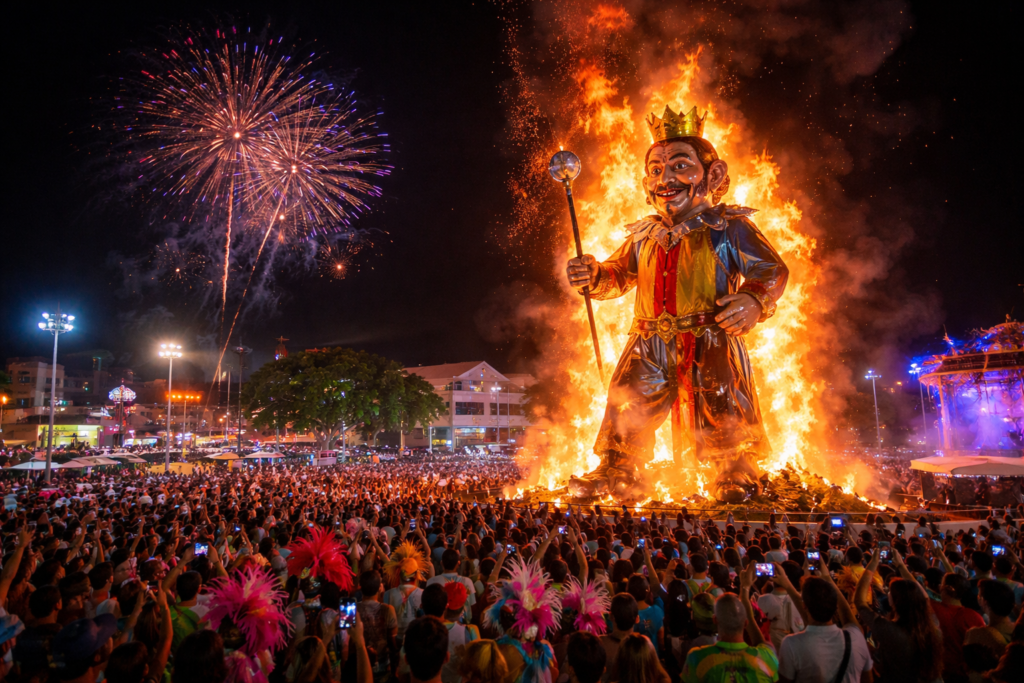
Few Carnival traditions capture the emotional intensity of a festival’s final night quite like the Burning of King Momo. In Aruba, this fiery farewell marks the official close of weeks of parades, music competitions, pageantry, and island-wide celebration. As the towering effigy of King Momo goes up in flames, the moment signals both an ending and a renewal – a symbolic release of Carnival’s exuberance and a collective reset before the Lenten season begins.
The Burning of King Momo 2026 will take place on Sunday, February 15, 2026, immediately following the Grand Carnival Parade in Oranjestad. As the towering effigy of King Momo goes up in flames, the moment signals both an ending and a renewal – a symbolic release of Carnival’s exuberance and a collective reset before the Lenten season begins.
More than spectacle, this is ritual, memory, and shared cultural expression – a night when the island gathers to close Carnival in the most unforgettable way possible.
Date, Time, and Location of King Momo Burning 2026
The Burning of King Momo 2026 is scheduled for Sunday, February 15, 2026, following the Grand Carnival Parade in Oranjestad. The ceremony traditionally begins in the late evening, typically around 8:30–9:00 PM, once the parade festivities conclude.
The event takes place near Plaza Betico Croes, in the heart of Oranjestad. This central square serves as one of Carnival’s primary gathering spaces and transforms into the ceremonial stage for the evening’s finale.
By late afternoon, the area begins to transform. Vendors set up food stalls, music fills the streets, and attendees claim viewing spots in anticipation of the night’s climax. The effigy of King Momo – often standing several metres tall and elaborately decorated – is positioned prominently near the main stage. Because this event marks the official close of Carnival season, attendance is typically high. The combination of open-air staging, live entertainment, and dramatic pyrotechnics makes the venue feel electric long before the ceremonial fire is lit.
Who Is King Momo – And Why Must He Burn?
King Momo is a symbolic figure rooted in Carnival tradition across parts of the Caribbean and Latin America. Often referred to as the “King of Carnival,” he represents joy, indulgence, and the temporary suspension of everyday restraint during festival season. When he is crowned at the beginning of Carnival, it signifies the start of celebration – music grows louder, costumes grow brighter, and daily routines give way to revelry. But Carnival, by design, is temporary. Its rhythm builds toward a dramatic conclusion. The burning of King Momo marks the symbolic end of excess – a farewell to the carefree spirit of Carnival and a return to normal life.
In Aruba’s Carnival culture, this ritual is not about destruction but transition. The effigy stands in for the collective experience of the festival itself. When it burns, the crowd witnesses the release of Carnival’s energy, closing one chapter while quietly anticipating the next.
How the Burning of King Momo Unfolds
The evening begins well before the official 9:00 PM ignition. Music pulses through the square as DJs and live performers warm up the crowd. Carnival queens, cultural representatives, and organisers often take to the stage to reflect on the season’s highlights and acknowledge participants.
As night deepens, attention turns toward the towering King Momo effigy. The crowd’s energy shifts from festive chatter to focused anticipation. Speeches are brief, and a countdown builds.
When the ceremonial flame is introduced, the moment unfolds quickly. Fire climbs the effigy’s frame, illuminating the square with flickering light. Applause, cheers, and emotional reactions ripple through the audience. For some, it is bittersweet – the end of weeks of preparation and celebration. For others, it is cathartic, a symbolic cleansing before the quiet of Lent.
The burning is carefully managed by local authorities to ensure safety, but its visual impact remains powerful. As the flames subside and embers glow, the crowd lingers, sharing final embraces and conversations that stretch late into the night.
King Momo’s Role in the 2026 Carnival Calendar
The Burning of King Momo occupies a sacred position within Aruba’s Carnival calendar. Carnival season begins weeks earlier with opening parades, musical competitions, youth pageants, and themed street celebrations. Each event builds momentum, culminating in the Grand Parade and, ultimately, the burning ceremony.
By the time Sunday, February 15, 2026 arrives, Carnival participants have invested months in costume design, choreography, and music rehearsals. The burning acts as the final punctuation mark – closing the season in a dramatic and memorable way.
In 2026, the ceremony will again serve as the official endpoint of Carnival festivities, drawing not only residents but also visitors who plan their trips specifically to witness this climactic ritual.
Practical Tips for Experiencing King Momo 2026
Attending the Burning of King Momo requires thoughtful planning, especially for first-time visitors eager to experience Carnival’s closing night at its fullest.
Arrive Early and Pace Your Day
Carnival’s final day is long and energetic. Since the burning follows the Grand Parade, plan for a full day in Oranjestad. Arriving early allows you to enjoy parade festivities, secure a good viewing location, and avoid last-minute crowd congestion.
Stay hydrated, take short breaks, and conserve energy for the late-evening ceremony.
Best Viewing Areas
The best vantage points are typically along the perimeter of Plaza Betico Croes, near designated viewing zones established by event organisers. Standing slightly elevated on sidewalk edges or near stage-facing areas provides clearer sightlines to the effigy and stage. Avoid overcrowded centre sections unless you are comfortable standing closely packed with others.
What to Bring
Keep your belongings minimal but practical:
- Comfortable walking shoes
- Light clothing suitable for warm evenings
- A small crossbody bag or secure pouch
- Cash for vendors
- A fully charged phone or camera
- Large bags and bulky items are discouraged, as movement can be restricted in dense crowds.
Is There a Ticket or Cost for the Burning of King Momo?
The Burning of King Momo in Aruba is generally free and open to the public, reinforcing its identity as a communal ritual rather than a commercial event. Anyone can attend and stand within public viewing areas without purchasing a ticket.
However, some premium viewing sections, VIP platforms, or adjacent concerts may require passes. Visitors should confirm details through Aruba’s official Carnival organisers closer to February 2026 for any updates regarding access, security, or seating arrangements.
Why Burning of King Momo 2026 Deserves a Spot on Your Aruba Island Bucket List
The Burning of King Momo 2026 captures the true essence of Carnival in a single night.
- It is dramatic yet authentic.
- Communal yet deeply personal.
- Symbolic yet visually unforgettable.
For culturally curious travelers, it offers depth beyond surface celebration. For photographers, it delivers one of the most compelling night visuals in the Caribbean festival calendar. For anyone seeking a meaningful cultural experience, it provides a rare opportunity to witness tradition, community, and emotion converge in real time.
On Sunday, February 15, 2026, as flames rise above Oranjestad and the crowd gathers in collective farewell, Aruba’s Carnival spirit will close with intensity – and leave behind a memory that lingers long after the embers fade.